For cooking · every number sourced
Dry White Wine for Cooking: A Plain Guide for Home Cooks
When a recipe calls for dry white wine for cooking, reach for a crisp, unoaked bottle such as Sauvignon Blanc, Pinot Grigio or dry vermouth. America's Test Kitchen found wines at $10 or less are generally fine for cooking 12. Skip sweet wines, oaky Chardonnay and salted "cooking wine."
By the editorial team · Updated 2026-11-25 · Every number linked to its source
Which wine for this dish?
Pick your dish in the wine-by-dish picker to see which dry white styles suit it, which to avoid, and the test result behind each pick.
Based on America's Test Kitchen tests and Woks of Life. 1234
Want it on paper? The Cooking Wine Cheat Sheet has every dish, wine style and substitute on printable pages.
Dry white wine for cooking shows up in pan sauces, risotto, steamed mussels, braised chicken and plenty of soups. The instruction sounds simple until you stand in front of a shelf of bottles with no idea which ones are dry, which are oaky, and whether the bottle labeled "cooking wine" is the same thing. This guide answers those questions in plain terms, with every number tied to a source you can check: what "dry" means, which grapes cook well, what to leave on the shelf, how much a recipe really uses, and what to do when you'd rather not use wine at all.
What "dry" means on a wine bottle
A dry wine is one with very little sugar left after fermentation. Europe puts a legal number on it: a still wine labeled dry may have no more than 4 grams of residual sugar per liter, or up to 9 g/L if its acidity is high enough to balance that sugar 5.
Other guides draw the line more loosely. Wine Folly, a widely used wine reference, calls under 1 g/L "bone dry" and treats anything from 1 to 17 g/L as dry 6. So two sources can disagree on the same bottle. For cooking, the practical test is simpler: if a wine tastes crisp rather than sweet, it will behave like a dry wine in the pan.
Two traps are worth knowing. First, acidity hides sugar, so a sharp, dry-tasting Riesling may carry more sugar than its taste suggests 7. Second, on sparkling wine the word means something sweeter: a sparkling wine labeled "dry" can hold 17 to 32 g/L 8. We found no US federal number for "dry" on still wine labels, so American bottles rely on style and grape rather than a legal term.
Which dry white wine for cooking to buy
When America's Test Kitchen (ATK) cooked the same dishes with a lineup of whites, Sauvignon Blanc came out ahead and dry vermouth finished just behind it 1. Their broader advice is that the best cooking wine is an "unremarkable" one: bright, balanced, not tannic, sweet or oaky 2.
| Style | How it cooks | Read more |
|---|---|---|
| Sauvignon Blanc | Crisp, high acid, the all-round pick | Sauvignon Blanc guide |
| Pinot Grigio | Light and neutral when Italian-style | Pinot Grigio guide |
| Unoaked Chardonnay | Fine; oaked versions are the problem | Chardonnay guide |
| Chenin Blanc, Albariño | Worth buying when labeled dry | Full ranking |
| Dry vermouth | Slightly herbal, keeps for months | Substitutes |
Fortified dry styles have a narrower role. Dry sherry worked in a robust chicken braise but its earthy notes took over delicate dishes like risotto in the same ATK test 1; the dry sherry page covers where it fits.
What to leave on the shelf
Sweet and off-dry wines are the most common mistake, because reduction turns a hint of sugar into an obvious one. ATK's tasters disliked what an off-dry Riesling did to savory food 1.
USDA data show how much sugar some grapes carry: Muscat has 5.23 g of carbohydrate per 100 g, against 2.05 g for Sauvignon Blanc 910.
Oaky Chardonnay is the second trap. Oak that tastes pleasant in a glass turned bitter, not woody, once ATK cooked it down, and inexpensive Chardonnay is often heavily oaked 1.
The third is the bottle labeled cooking wine. It is salted on purpose: federal rules require at least 1.5 g of salt per 100 ml in salted wine 11. That salt makes your seasoning harder to control, and ATK found these wines have little flavor of their own 12. The cooking wine vs regular wine page lays out the full comparison.
Do you need an expensive bottle?
No. ATK tested more than 30 bottles for cooking and concluded that wines at $10 or less are generally fine, while far pricier bottles gave minimal benefit 12. Some tasters noticed a bit more complexity in pan sauces with the expensive wines, but not enough to change the advice.
What matters more than price is style. A cheap, crisp, dry white beats an expensive bottle that is sweet or oaky, because cooking concentrates whatever the wine brings 2. If you cook with wine often, boxed wine is worth a look: the bag inside collapses as you pour, so air stays out and the wine keeps longer 13.
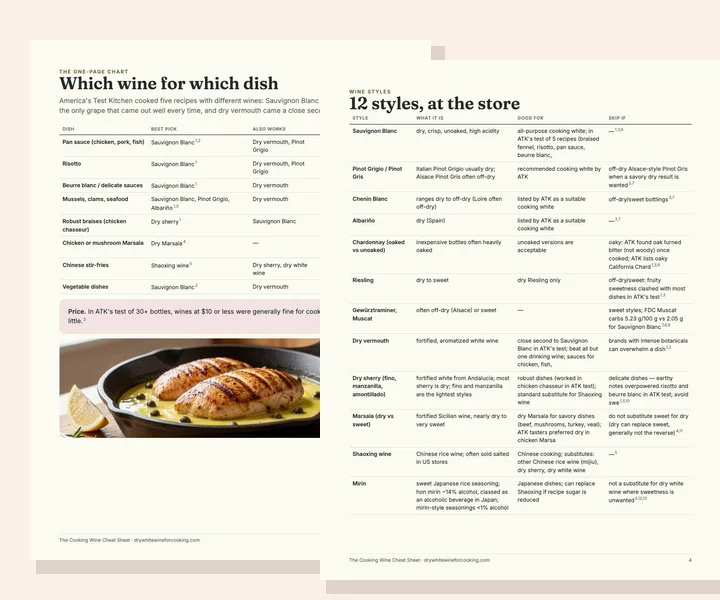
Free printable · 13 pages
Get The Cooking Wine Cheat Sheet
Keep the one-page wine-by-dish chart from The Cooking Wine Cheat Sheet taped inside a cabinet door, so the next recipe that says "dry white wine" needs no guesswork at the store.
- Which wine for which dish, on one page
- 12 wine styles: what to buy, what to skip
- Every substitute with its ratio
- USDA alcohol-left table, storage notes · US Letter and A4
How much wine recipes actually use
Most recipes use far less than a bottle. A pan sauce for four takes about half a cup in ATK's version 14, and risotto takes more, around a cup per pot in a standard four-serving recipe 15. Braises and steamed shellfish vary widely, so follow the recipe and use the risotto page for rice-specific timing.
A standard US bottle holds 750 ml, which works out to about 3.2 cups or roughly 50 tablespoons 16. One bottle can cover several pan sauces, which is why storing the rest matters.
Keeping an opened bottle
An opened bottle of white keeps for days, not weeks, in the fridge, and the two main sources we use don't agree on exactly how many 1718. Re-cork it, chill it, and use it for cooking first while it still tastes fresh.
Cooks who open a bottle only occasionally have two easy outs: freeze the rest in small portions for future sauces 13, or keep dry vermouth, which lasts months once opened 3. Day counts, boxed wine and freezing steps are in our opened wine storage guide.
When you'd rather not use wine
Some cooks skip wine for health, family or religious reasons, and a common belief is that the alcohol simply burns off. It does not, at least not completely. USDA retention figures show that food simmered for 2 1/2 hours still keeps about 5% of the alcohol added, and a quick stir into hot liquid keeps far more 19. The alcohol cook-off page explains what those numbers mean so you can decide for yourself.
Leaving wine out is easy in most recipes. Broth sharpened with a little vinegar or lemon juice does most of the job 20, and the substitutes guide gives exact ratios, other options and where sources disagree.
Where to go next
Pick the page that matches the bottle or the question in front of you:
- Ranking by style and dish: best white wine for cooking
- Grape guides: Sauvignon Blanc, Pinot Grigio, Chardonnay
- Fortified whites: dry sherry for cooking
- Red wine recipes: best red wine for cooking
- Salted bottles: cooking wine vs regular wine and can you drink cooking wine
- Alcohol and storage: does alcohol cook off and how long opened wine lasts
- Dish-specific: white wine for risotto
Frequently asked questions
Can you use dry white wine for cooking?
Yes. Dry white wine is what most savory recipes mean when they say "white wine." It adds acidity and depth to pan sauces, risotto, seafood and braises without making the dish sweet. Choose a crisp bottle with no obvious oak or sweetness; America's Test Kitchen advises a bright, balanced, "unremarkable" wine over anything showy 2.
What kind of white wine is dry?
Most Sauvignon Blanc, Italian Pinot Grigio, Albariño and unoaked Chardonnay are dry, as is dry vermouth. Under EU rules a still wine labeled dry has no more than 4 g of residual sugar per liter, or up to 9 g/L when acidity balances it 5. Riesling, Chenin Blanc and Alsace Pinot Gris can go either way, so check the label.
Can you give me a list of dry white wines?
For cooking, the dependable dry whites are Sauvignon Blanc, Italian-style Pinot Grigio, Albariño, dry Chenin Blanc, unoaked Chardonnay and dry vermouth. America's Test Kitchen recommends several of these as cooking wines 2. Dry sherry styles such as fino and manzanilla are also dry, but their strong flavor suits robust dishes better than delicate ones.
What white wine for bolognese?
Any crisp, dry, unoaked white works. Bolognese simmers for a long time with meat, tomato and milk, which smooths over small differences between wines, and America's Test Kitchen saw wine choice matter far more in gentle dishes than in hearty ones 1. So an everyday Sauvignon Blanc or Pinot Grigio is fine. Avoid sweet or oaky bottles, whose flavors concentrate over the long cooking time.
What do you use when a recipe calls for dry white wine?
Use a crisp, unoaked dry white such as Sauvignon Blanc or Pinot Grigio, or dry vermouth in equal amounts. Without wine, broth sharpened with lemon juice or wine vinegar is America's Test Kitchen's go-to replacement 20; our substitutes page gives the amounts. Stir the acid in near the end so it stays bright.
Sources
- America's Test Kitchen / Cook's Illustrated: What's the best white wine for cooking?
- America's Test Kitchen / Cook's Illustrated: The best wine for cooking is not what you think
- America's Test Kitchen / Cook's Country: Substituting vermouth for white wine in cooking
- The Woks of Life: Substitutions for Shaoxing wine
- European Commission (text via legislation.gov.uk), 2019: Commission Delegated Regulation (EU) 2019/33, Annex III Part B — sugar content terms for wines other than sparkling
- Wine Folly: Sweetness in Wine – Wine 101 Videos (Ep. 5)
- Wine Folly: Wines from dry to sweet (chart)
- European Commission (text via legislation.gov.uk), 2019: Commission Delegated Regulation (EU) 2019/33, Annex III Part A — sugar content terms for sparkling wines
- USDA FoodData Central (SR Legacy), 2019: Alcoholic beverage, wine, table, white, Muscat (FDC ID 174849)
- USDA FoodData Central (SR Legacy), 2019: Alcoholic beverage, wine, table, white, Sauvignon Blanc (FDC ID 173201)
- US eCFR / Cornell LII (TTB regulation), 2025: 27 CFR 24.215 — Production of nonbeverage wine and wine products
- America's Test Kitchen / Cook's Country: Cooking with wine (how-to 5887)
- America's Test Kitchen: Cooking with wine (how-to 5706)
- America's Test Kitchen / Cook's Illustrated: White Wine Pan Sauce (recipe 7794)
- Pillsbury: Classic Risotto
- US eCFR / Cornell LII (TTB regulation), 2025: 27 CFR 4.72 — Standards of fill for wine
- America's Test Kitchen: The best way to save leftover wine
- Wine Folly: How long does an open bottle of wine last?
- USDA Agricultural Research Service, Nutrient Data Laboratory, 2007: USDA Table of Nutrient Retention Factors, Release 6
- Cook's Illustrated / America's Test Kitchen: How to substitute for wine